
🍎 Apple accelerates in artificial intelligence as Meta poaches its Siri architect
💻 New Macs and Vision Pro with M5 chip: more power, more AI, more autonomy 🧠 The defection of a key engineer to Meta reignites the debate over Siri’s future

Apple is strengthening the artificial intelligence of its products with new chips and upgrades, but it’s also facing a strategic talent drain to Meta amid the escalating AI talent war.
In recent days, Apple has unveiled a wave of updates centered on one goal: boosting AI integration across all its devices. The Cupertino-based company has refreshed its 14-inch MacBook Pro with the new M5 chip, a generational leap in performance and efficiency. At the same time, it has upgraded its Vision Pro mixed-reality headset, now also powered by the M5, with improvements in speed, graphics, and battery life. Everything points to Apple stepping on the gas in the AI race — although it faces a significant challenge: Meta has hired the engineer who was meant to lead the next generation of Siri, Apple’s voice assistant.
⚙️ More powerful chips and on-device AI
The new Apple M5 represents a major leap forward from the M4. It keeps the same 10-core CPU (four performance cores and six efficiency cores), a 10-core GPU, and a 16-core Neural Engine, but delivers 15% more processing power and up to 45% better graphics performance. Each GPU core now integrates a dedicated Neural Accelerator that allows machine learning tasks to run up to 3.5 times faster.
This means the new Macs can execute complex AI models directly on the device, without relying heavily on cloud processing. This “edge AI” approach — running intelligence locally — enhances privacy and reduces latency.
The MacBook Pro M5 retains its familiar design but improves in speed, efficiency, and battery life, now reaching up to 24 hours per charge. It can be configured with up to 4 TB of SSD storage and 32 GB of unified memory. In Europe, however, some controversy has arisen: certain models are being sold without a charger, a move Apple attributes to environmental policies.
The new iPad Pro with the same chip also gains from these upgrades, boasting 3.5 times greater AI performance and more realistic graphics thanks to third-generation ray tracing. With the M5 family, Apple aims to make its devices capable of running next-gen AI models locally, embedding intelligence deeply into the ecosystem without relying on external services.
🥽 Vision Pro M5: faster, lighter, and slightly cheaper
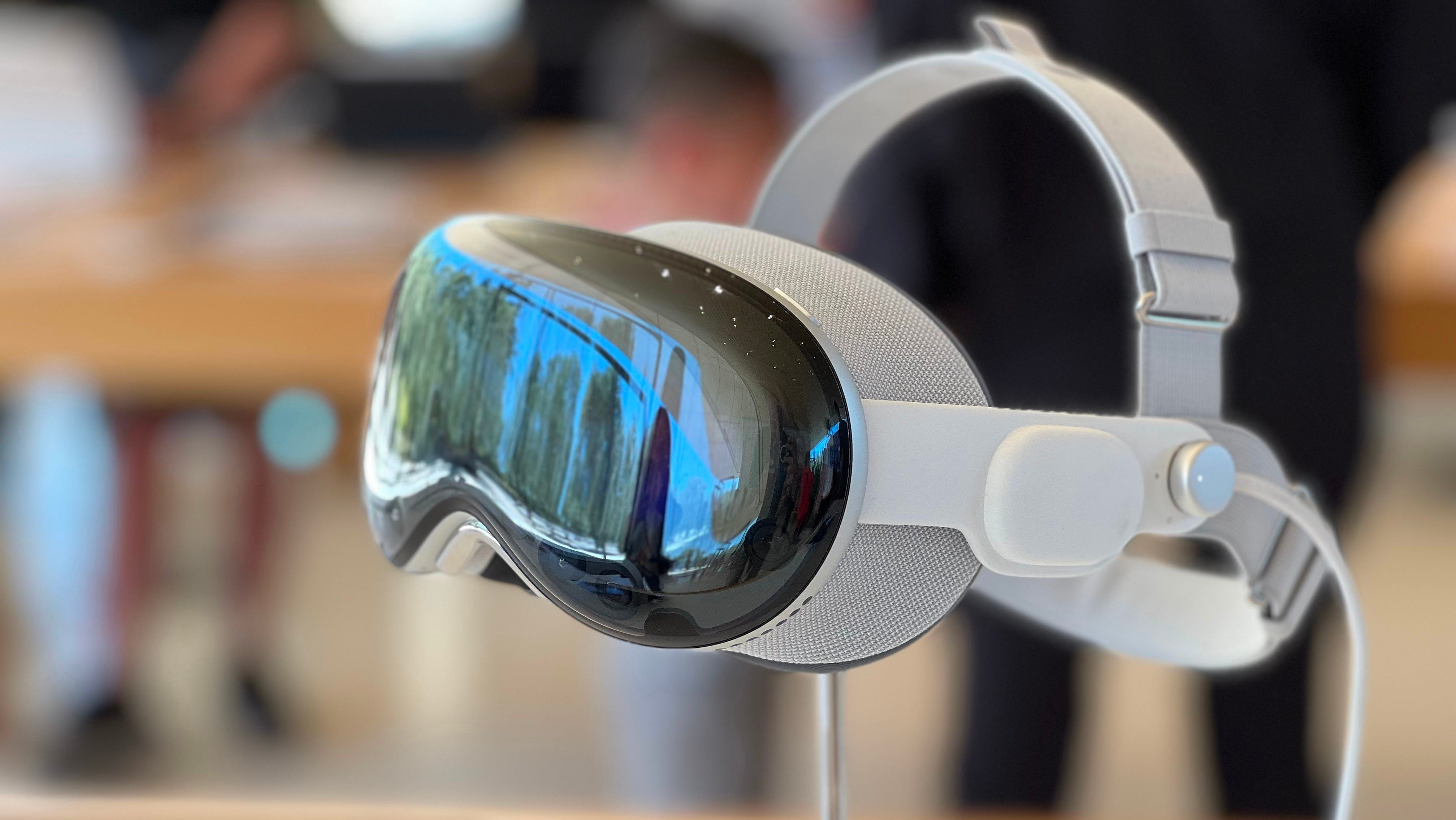
The Apple Vision Pro, introduced in 2023 as the company’s first “spatial computer,” now arrives in an upgraded version featuring the M5 processor. This 3-nanometer chip allows smoother app performance, renders 10% more pixels on the micro-OLED displays, and boosts the refresh rate to 120 Hz for sharper, more fluid visuals.
Energy efficiency also improves: the headset now achieves up to three hours of video playback, about 30 minutes longer than before, without gaining weight. Apple has added a new Dual Knit strap, designed for better comfort and weight distribution during extended use.
The external design remains unchanged, but there’s a pleasant surprise: a modest price drop. In France and Germany, the Vision Pro M5 starts at €3,699, roughly €300 less than its predecessor. Still, it remains an exclusive and limited product, available in only about ten markets, including the U.S., U.K., France, and Germany. Spain remains off the list for now.
More than two years after its debut, the Vision Pro remains more of a tech experiment than a mass-market product. Apple is advancing cautiously, refining the hardware and waiting for the ecosystem and developers to catch up.
💻 A touch-screen MacBook Pro on the horizon
After years of resistance, Apple now seems ready to embrace touch screens on Macs. According to Bloomberg, the company is developing a MacBook Pro with an OLED touch display, expected between late 2026 and early 2027.
Codenamed K114 and K116, the models will feature a thinner, lighter chassis, the upcoming M6 chip line, and a notchless screen design replaced by a small camera hole — similar to the iPhone’s Dynamic Island. Apple has also designed a reinforced hinge system to prevent screen wobble during touch interaction.
Unlike an iPad, this Mac will keep its full-size keyboard and trackpad, letting users switch freely between touch and traditional controls. It’s a striking shift for Apple, which for years argued that vertical touch screens were ergonomically flawed. But the growing demand for hybrid devices and the popularity of iPad Pros with keyboards have pushed the company to rethink its stance.
The touch-screen MacBook Pro will likely cost several hundred dollars more than current versions, though Apple will test the market with its high-end line before expanding the feature to other models.
🧠 Meta poaches the brain behind Siri’s next evolution
While Apple races forward in hardware, it faces turbulence on the human front. The battle for AI talent among Big Tech firms has intensified — and Tim Cook’s company has taken a hit.
Ke Yang, a senior engineer recently appointed to lead Apple’s AKI project (Answers, Knowledge and Information), has left the company to join Meta. His team had been developing a generative AI system designed to modernize Siri and improve Safari’s search capabilities, turning Apple’s assistant into a far more conversational tool capable of understanding complex questions and providing up-to-date, contextual answers.
Yang’s exit follows a string of over ten AI specialists who have departed Apple in recent months — several of them lured by Meta with multi-million-dollar compensation packages. Mark Zuckerberg’s company has reportedly been offering contracts exceeding $100 million to attract top AI engineers.
Industry insiders describe this as a “crisis of confidence” within Apple’s AI strategy. While Google, Microsoft, and Meta roll out new generative tools almost monthly, Apple has opted for a more cautious approach, focusing on seamless integration and privacy rather than public-facing chatbots.
Still, Tim Cook insists that Apple remains “fully committed” to advanced AI development. The company has opened new research centers in Zurich, working on a redesigned Siri architecture built on large language models. The goal is to transform Siri from a scripted responder into an intelligent, context-aware conversational agent.
🔮 Apple’s dual challenge: technology and talent
The loss of key figures like Ke Yang forces Apple to reorganize its AI teams and accelerate leadership replacements. While analysts speculate about potential collaborations with companies like OpenAI or Anthropic, Apple seems determined to keep control in-house — prioritizing privacy and ecosystem consistency.
The company stands at a pivotal crossroads. On one side, it’s equipping its flagship devices — the Mac, iPad, iPhone, and Vision Pro — with hardware optimized for on-device AI. On the other, it must win the war for human talent to turn that potential into real innovation.
In an industry where algorithms evolve monthly, Apple now faces the test of proving it can stay ahead not only through design and silicon, but also by attracting and retaining the brightest minds. The upcoming Siri updates and the arrival of the M6 chips will be a defining test of whether the Cupertino giant is ready to lead the next era of artificial intelligence.